Do the bacterial organisms living in dirt make any difference in how well our food is grown? That is the question that two major crop‑microbiome research initiatives are trying to find out.
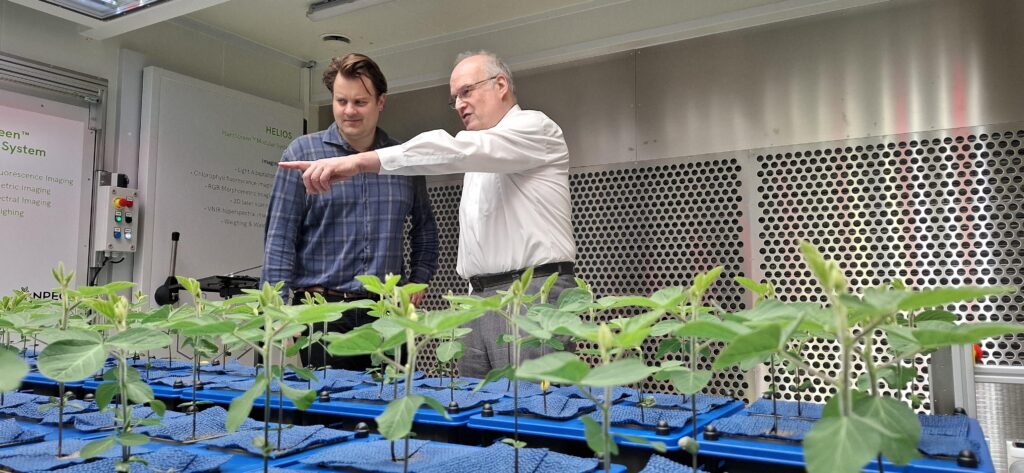
The Netherlands Plant Eco-phenotyping Centre (NPEC) in Utrecht is home to a collection of 100 soils from soya bean crops across Europe. Here, researchers from MICROBIOMES4SOY and MiCrop are examining those soils to better understand what kind of microbiomes are found in them, and how those microbiomes could be contributing to soya bean growth.
The scientists leading these efforts are Paul Schulze-Lefert from MPIPZ and Roeland Berendsen and Corné Pieterse from Utrecht University. Working behind the scenes on the soil experiments are PhD researchers Maria Papadopoulou and Wietze Metzelaar, who manage the collection of soils in the NPEC facility.
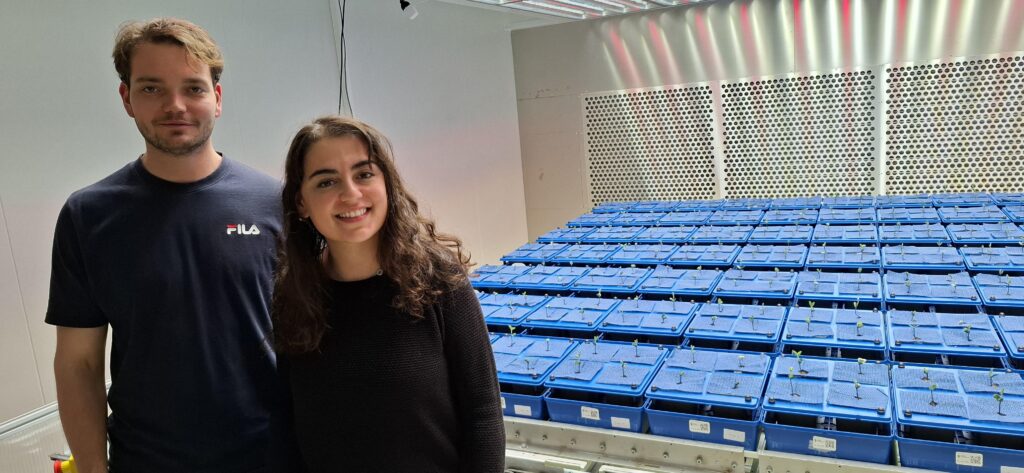
The group of researchers came together to view the 100‑soil soya bean microbiome experiment currently underway. Both projects are examining these soils to simultaneously address their research questions. While MICROBIOMES4SOY is focused on analysing which microbes are present in the soils and testing how they affect soya bean phenotypes, MiCRop’s PhD researcher Wietze is specifically investigating how soil microbiota influence sulphur nutrition in soya bean crops.
The shared focus of both projects creates a unique opportunity to observe, compare, and discuss how both approach high‑resolution plant phenotyping and microbiome‑function experiments at the NPEC.
The discussion has already inspired plans for a collaborative experiment within MICROBIOMES4SOY, where the team will test soya bean “collaboromes” identified by Qi Wang from MPIPZ within the experimental framework at Utrecht University.
Shared vision: microbiomes as drivers of resilient crops
MICROBIOMES4SOY and MiCRop are aligned in the scientific vision that the plant microbiome is a powerful lever to:
- boost crop performance,
- enhance resilience to environmental stress, and
- reduce reliance on external inputs such as fertilisers and pesticides.
This shared commitment reflects a broader shift in European agricultural research: understanding and harnessing beneficial microbiomes as a cornerstone of future sustainable cropping systems.
Supporting Europe’s protein transition
Soya bean is a central crop in Europe’s transition toward more plant‑based proteins and lower agricultural emissions. Insights emerging from both MICROBIOMES4SOY and MiCRop, particularly on how soil microbiota influence nutrient acquisition and stress tolerance, have the potential to:
- improve the reliability of soya bean production in European climates,
- reduce agrochemical inputs, such as chemical fertilisers and pesticides, and
- make European-grown soya bean a more robust and sustainable alternative to animal protein systems.
By integrating mechanistic knowledge, ecological context, and high‑precision phenotyping, the two projects can accelerate the development of microbiome‑informed strategies for European protein crops.
Looking ahead: closing key knowledge gaps together
Both programmes recognise that large knowledge gaps remain, particularly around establishing causal links between microbiome composition and plant performance. Future collaboration between MICROBIOMES4SOY and MiCRop offers a unique opportunity to address these challenges by connecting:
- mechanistic understanding from controlled experiments,
- ecological insights across diverse soil contexts, and
- applied perspectives on the field.
Such a multi‑scale approach is essential for moving from isolated observations to predictive, systems-level understanding of plant–microbiome interactions. Ultimately, this collaboration will contribute to designing microbiome‑based innovations that are robust, scalable, and effective on the ground.