Is Soya Good or Bad for You? Here’s What the Science Says. (EUFIC Article)

Soya has sparked widespread debate in health and nutrition circles — some praise it as a nutritional powerhouse, while others question its safety.

MICROBIOMES4SOY partner, The European Food Information Council (EUFIC) wrote an article entitled Is Soy Good or Bad for You? Here’s What the Science Says”, providing an in-depth, evidence-based exploration of soya’s role in human health, complementing the research focus of Microbiomes4Soy.

📢 Read the full EUFIC article here: Is Soy Good or Bad for You? Here’s What the Science Says.

The MICROBIOMES4SOY project explores how beneficial microbes can enhance soya’s performance, making it more resilient in agriculture, optimising aquaculture feeds, and improving the health benefits of soya-based diets. Through our research, we aim to unlock the full potential of soya, contributing to more sustainable food systems.

Stay tuned for more updates from MICROBIOMES4SOY as we continue advancing sustainable food solutions.


Soy contains a wide range of nutrients, including as a source of high-quality protein that is well-digested. Soy also contains all nine essential amino acids in consistent amounts. The image below shows the protein content in various soya products.
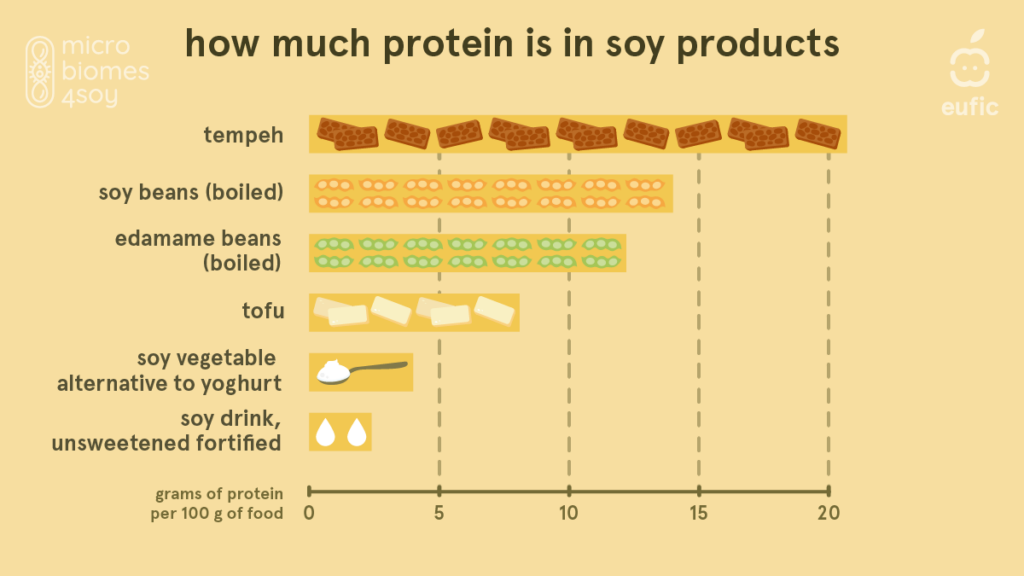
Source: The European Food Information Council (EUFIC)
SHARE:

Understanding Soya Plant Microbiomes: Enhancing Crop Productivity

MICROBIOMES4SOY aims to explore the dynamics and potential of plant microbiomes, specifically focusing on the soya bean model. The project seeks to understand how plant microbiomes impact soya crop productivity. Additionally, it aims to develop microbiome-informed approaches, including agricultural strategies and prediction models, to improve yield stability, promote environmental sustainability, and ensure food safety and quality during production.

Soya-Based Aquafeeds: Innovating Aquaculture Sustainability

In the realm of aquaculture, MICROBIOMES4SOY seeks to pioneer solutions by creating innovative soya-based aquafeeds. The project aims to evaluate the effects of these novel feeds on the fish gut microbiome and overall health, addressing both environmental and nutritional aspects of aquaculture.

Joint Efforts for Food Systems Transformation

MICROBIOMES4SOY aims to work collaboratively with food system stakeholders to define regional transition pathways towards plant-based protein diets, contributing to broader shifts in dietary practices.

Improved Microbiome-Based Knowledge and Skills for Food System Actors

Knowledge and skill empowerment is a key objective, intending to equip food system actors with expertise on microbiome interactions, benefits, and industrial applications. This will be achieved through a multi-actor approach, that shares understanding of microbiomes within the broader context of food systems.

Microbiome-Informed Dietary Recommendations:
Exploring Human Health Impacts

Moreover, human health is a central theme, with a dedicated objective to investigate the impact of soya-derived protein diets on the human gut microbiome. The project aims to provide microbiome-informed dietary recommendations, contributing valuable insights to the intersection of nutrition and microbiology.